 Modernizing Social Protection in Culture
The Social Safety Net in Culture Initiative aims to strengthen the socioeconomic security of artists, artisans and cultural workers through three pillars of social protection.
The cultural sector is experiencing growing structural precarity, particularly among artists, artisans, and cultural workers. Despite their essential role in the artistic, sociocultural, and socioeconomic vitality of Québec and Canada, these professionals all too often work under conditions of financial insecurity, without an adequate social safety net to help them navigate the uncertainties of their professional reality—conditions that also have a harmful effect on their private and family lives.
This situation is documented in multiple studies produced by Compétence Culture and during the Culture in Action initiative, a large-scale consultation that was carried out in 2022 with the cultural sector:
- Diagnosis on Human Resources Issues in the Cultural Sector
Final report of the survey and focus groups conducted in March and April 2022
Produced by Compétence Culture and carried out by Dynamo, September 2022 - Analysis of the Economic Contribution of Culture, the Impact of the Pandemic and Support Measures
Produced by Compétence Culture and carried out by AppEco inc., May 2022 - Human Resources Action Plan for Culture 2023–2028
Produced and carried out by Compétence Culture, March 2023

Key Figures
in arts and culture in Québec
Self-employment – Temporary contracts – Hybrid professional status – Artistic entrepreneurship
do not have access to group insurance or RRSPs
do not benefit from or contribute to the Québec Pension Plan
do not have access to Employment Insurance

From Collaboration to Action
More than 50 organizations in the cultural sector have formally expressed their support for this initiative and have identified Compétence Culture as the organization best positioned to lead the Project.
Compétence Culture is therefore launching a large-scale, sustainably designed initiative to strengthen the social safety net for artists, artisans, and cultural workers. This unifying effort is designed to adapt social protection mechanisms to the atypical professional trajectories that characterize the cultural sector.
The Pillars of the Social Safety Net in Culture
A
Employment Insurance and Income Support Benefits
- A1 – Income replacement
(job loss, maternity leave, parental leave, or sick leave)
- A2 – Guaranteed minimum income
B
Group Insurance and Retirement Plans
- Access to medical care and prescription drug coverage
- Disability benefits
- Québec Pension Plan
- Canada Pension Plan
- Group Insurance Plan
C
Tax Measures
- Income averaging – Tax credits
- Other measures
The Social Safety Net in Culture Initiative is structured as a collaborative space for developing sustainable solutions.
By mobilizing expertise, data, and field experience, this collective project seeks to develop structuring models adapted to the professional realities of the sector. Its objective is to build a more equitable and resilient professional environment, better aligned with the specificities of cultural work.
Deploying a Collective Approach Based on a Collaborative Governance Structure
The Social Safety Net in Culture Initiative is based on an ethical and interdisciplinary governance structure, bringing together a broad network of sectoral and institutional partners (municipal, provincial, national) each playing complementary roles while upholding their respective mandates:
- Unions – Associations – Sectoral and regional coalitions
- Artists – Artisans – Cultural workers
- Experts – Researchers – Representatives from ministries and arts councils
Three bodies are created and work together:
- A Coordination Committee to oversee the work
- A National and Interdisciplinary Advisory Table to ensure coherence and legitimacy of orientations
- Working Groups composed of individuals with targeted expertise. Each working group focuses on one of the three pillars of social protection.
Architecture of the Social Safety Net in Culture Initiative
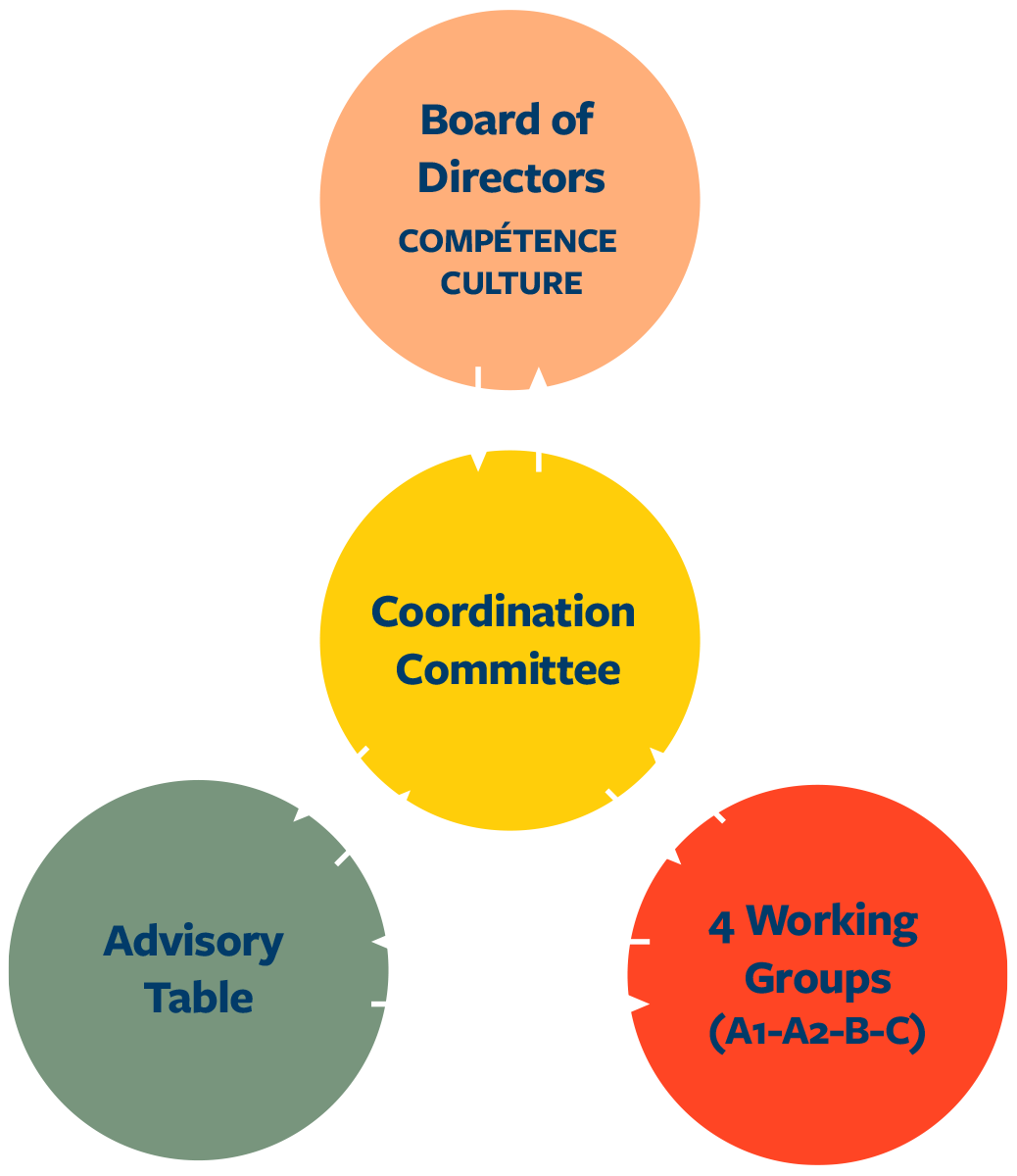
MANDATE – Board of Directors of Compétence Culture
The fiduciary and decision-making authority of the mandated organization. It approves strategic orientations, the governance framework, and the final recommendations resulting from the Initiative, thereby ensuring the project’s compliance, legitimacy, and institutional anchoring. It guarantees institutional legitimacy, compliance, and coherence.
MANDATE – Coordination Committee
The Initiative’s supervisory and steering team is made up of four individuals mandated by Compétence Culture. It is responsible for planning, ensuring cross-stage coherence, facilitating communication between bodies and monitoring deliverables. It serves as a transmission and oversight link between the technical and strategic levels.
MANDATE – Advisory Table
An intersectoral governance body that brings together key stakeholders from the cultural sector (associations, unions, arts councils, public partners, and experts) to collectively validate findings and recommendations. Its members play an active role in disseminating results and in sector-wide consultation activities. The Table reflects the sector’s diversity and confers upon the Initiative its democratic and inclusive character.
MANDATE – Working Groups
Specialized analysis committees responsible for the three pillars of the Initiative. They produce the research, models and scenarios on which sectoral recommendations are based. Serving as the project’s scientific and technical backbone, they provide the analyses and modeling required for decision-making.
Process
Methodology
- Review of existing literature and statistical analysis
- Requests for public data from ministries and governmental bodies
- Surveys and consultations with the cultural sector to account for all professional statuses
- Expert workshops (e.g., actuarial firms)
- Impact analysis and budget scenario planning
Deliverables
- Four situational assessments (pillars A1, A2, B, C)
- Four modelling series
- A coordinated set of recommendations (Québec/Canada)
- A sectoral knowledge transfer toolkit detailing the specificities of applying social protection mechanisms
Outcomes
- Improved social safety net
- Reduction of blind spots (atypical work, intermittency, multi-status workers)
- A shared roadmap to improve working conditions in the cultural sector
- Creation of models transferable to other economic sectors
May
2025
Dialogue
- Compétence Culture is mandated by its members to act as project lead

Fall
2025
Structuring
- Project Architecture and governance
- Communications
- Formation of the four working groups

Winter
2026
Launch of Work
- Information sessions
- Creation of the Advisory Table
- Start of working groups’ activities
Spring
2026
Consultation and Diagnosis
- Start of consultation activities
- Situation reports under development
- Sector-wide coordination activities (May 20)
Fall
2026
Consultation and Diagnosis
- Sector-wide coordination activity
- Dissemination of initial findings from the situation reports
- Pan-Canadian coordination
Winter
2027
Modeling
- Initial modeling
- Validation of models by the Advisory Table
- Advocacy strategies led by the Advisory Table
Spring
2027
Modeling
- Modeling and adjustments
- Validation of models by the Advisory Table
- Consultation, collaboration, and information activities
Fall
2027
Recommendations
- Final recommendations and feasibility plan submitted to the Advisory Table
- Knowledge transfer activity with the sector
- Sectoral adoption and implementation of the recommendations
ONGOING:
- Fundraising efforts (provincial, federal, private, foundations)
- Partnership outreach with provincial and federal interest groups
An Initiative For and By the Sector
This unprecedented project in the cultural field seeks to collectively equip the sector to build more equitable, inclusive, and sustainable protection mechanisms.
Compétence Culture, acting as project lead and facilitator, invites all partners, organizations, artists, artisans, and cultural workers to follow and participate in upcoming mobilization and collaboration activities.
Several cultural organizations and associations have already expressed their support by signing a letter of support for the Social Safety Net Initiative in Culture, led by Compétence Culture.
Information Sessions
- June 11, 2026: Les Arts et la Ville Forum
Roundtable: Creating Conditions to Make a Living from Culture in the Regions: Toward a Social Safety Net Adapted to Territorial Realities - June 11, 2026: Annual General Meeting of Culture Mauricie members
Presentation and activity on the Social Safety Net Initiative - June 4, 2026: National Research Group of OPSAC (Public Organizations Supporting Arts in Canada) – With the support of CAM and CALQ
Presentation of the initiative - April 27, 2026: Canadian Arts Service Organizations – Mass Culture
Presentation of the initiative - March 26, 2026: Virtual information session for Québec’s cultural sector
Presentation of the initiative - March 24, 2026: Canadian cultural organizations – Culture at Work Canada
Presentation of the initiative - March 19, 2026: Virtual information session for Québec’s cultural sector
Presentation of the initiative
Upcoming Collaboration and Consulting Activities
- May 20, 2026: Collaboration day focused on the pillars of the Social Safety Net in culture
Activity reserved for cultural organizations: professional associations, unions, sectoral and regional coalitions, institutional partners, and academic researchers
Calls for participation, surveys, and public presentations will be announced throughout the process.
A plurality of teams with diversified skill sets
COORDINATION COMMITTEE

Pascale Landry
_
Executive Director, Compétence Culture
Gilles Charland
_
Strategic Advisor
Sylvie Meste
_
Cultural Affairs Consultant

Christine Harel
_
CHRP, HR Consultant | Organizational Development
WORKING GROUPS

Pierre Céré
_
Group Lead
Employment Insurance
MEMBERS:
Milan Bernard
Stanley Péan
Diane Viau
Gilles Charland
_
Group Lead
Insurance and Pension Plans
MEMBERS:
Stéphane Chagnon
Marie-Eve Gagnon
Julie-Anne Richard
Christian Robitaille
1 vacant position

Geneviève Lauzon
_
Group Lead
Tax Measures
MEMBERS:
Carlos Moreno
Chantale Shedleur

Parise Mongrain
_
Group Lead
Income Support
MEMBERS:
Pascale Bédard
Marie-Pierre Boucher
Jean-Michel Cousineau
Eve-Lyne Couturier
Martine D’Amours
Karla Etienne
Ambre Fourrier
Louise Harel
ADVISORY TABLE
Composition of the target group: 18 to 22 individuals with the following expertise:
- Diversity and plurality of the sector
- Knowledge of the cultural sector (global perspective, disciplinary and regional issues, labor market, HR, research, politics, economics, EDI)
- Political and strategic skills
- Expertise in social safety net issues in culture
- Territorial coverage
The composition of the Advisory Table is currently being validated by the Board of Directors of Compétence Culture.
Support for the Initiative
The organizations and networks listed below have expressed their support for the Social Safety Net in culture Initiative led by Compétence Culture by signing a support letter. Their commitment highlights the importance of this initiative for the cultural sector and the challenges associated with evolving working conditions.
Associations and networks wishing to join this effort can download and sign the letter here:
Once signed, it must be sent to developpement@competenceculture.ca. It may also be shared with relevant parties by copying this address.
Organizations Supporting the Initiative
Association des cinémas parallèles du Québec
Association des compagnies de théâtre
ACTRA Montréal
Association des écoles supérieures d’art du Québec
Association des professionnels des arts de la scène du Québec
Association québécoise des auteurs dramatiques
Association Québécoise des Marionnettistes
Arrimage, Corporation culturelle des Îles-de-la-Madeleine
Les Arts et la Ville
Le Théâtre Aux Écuries
Conseil des arts de Montréal
Conseil des arts et des lettres du Québec
Culture Bas-Saint-Laurent
Centre des auteurs dramatiques
Conseil de la formation continue arts et culture de Montréal
Conseil de la culture de l’Estrie
Conseil québécois de la musique
Conseil québécois du théâtre
Culture à l’œuvre Canada
Culture Côte-Nord
Culture Gaspésie
Culture Laurentides
Culture Montréal
Culture Saguenay – Lac-Saint-Jean
Diversité Artistique Montréal
La danse sur les routes du Québec
En Piste, regroupement national des arts du cirque
Fédération culturelle canadienne-française
Guilde des musiciens et musiciennes du Québec
Guilde canadienne des réalisateur·trices
Illustration Québec
Institut national de l’image et du son
Kassiwi Média
Minwashin – Arts, Savoirs et Territoires
Quebec Drama Federation
Regroupement du conte au Québec
Regroupement de pairs des arts indépendants de recherche et d’expérimentation
RIDEAU – Association professionnelle des diffuseurs de spectacles
Réseau des organisateurs de spectacles de l’est du Québec,
Regroupement québécois de la danse
Société des auteur·e·trice·s de radio, télévision et cinéma
Scènes de musique alternatives du Québec
Société des musées du Québec
Société professionnelle des auteurs compositeurs du Québec et des artistes entrepreneurs
Théâtres associés
Travail Sans Frontières
Théâtres Unis Enfance Jeunesse
Union des artistes
Compétence Culture thanks the Ministry of Culture and Communications, the Conseil des arts de Montréal, and Caisse de la Culture – Desjardins for their financial support with respect to the Initiative.
Together, let’s protect those who bring arts and culture to life!



Newsletters
Newsletters are regularly distributed to our mailing list, offering updates on activities related to the Social Safety Net Initiative. Previously issued newsletters can be accessed here:
OUR PARTNERS
LEAD BY